
Teewire POS - Tee Sheet, POS and Marketing All-in-One Solution for Golf Courses
All-in-One Golf Course Management Software: Who Picks Up the Phone?
Every operator has a list of things they would change about the software they run. What separates one vendor from the next is where that list goes, and whether the person who receives it can do anything about it.
Q&A with Bay Paul, Founder of TeeWire
TeeWire is an all-in-one golf course management system built and supported in the United States. Ask any golf course operator what they would change about the software they run, and the list comes back the same three or four things every time. The golf shop wants a tee sheet that is genuinely easy to use. The golf pro wants fewer no-shows and short-shows, and wants a frost delay text to reach the morning's golfers in one move. The accounting office wants the grill and the greens fees on the same report.
Every operator has that list. What varies is where it goes. At TeeWire it goes to a published program with a public leaderboard, and it reaches a founder who ran golf courses for a decade and has the technical background to build the software himself.
What is TeeWire?
TeeWire is an all-in-one golf course management system founded in 2016 by Bay Paul and based in Clarkston, Michigan. TeeWire runs the tee sheet, online tee time booking, point of sale, food and beverage, member billing, a double entry general ledger, reporting and the course website on one database, with development and support 100% U.S. based and in-house.
More than 300 golf courses work with TeeWire across websites, marketing, tee sheets and point of sale. CourseLogix was founded in 2005, and in 2026 the two merged under the TeeWire name, so the course website and the software that runs the course come from one company. TeeWire and CourseLogix have been building golf course software and websites since 2005.
Who answers when a golf course calls TeeWire support?
TeeWire answers its own support calls from the United States, with development and support 100% U.S. based and in-house, and returns calls the same day. TeeWire staffs that phone with people who know golf operations as well as the software, and courses reach the people who write the code when something needs changing.
Support runs through one number, (810) 775-2035, and a communications system TeeWire builds into the tee sheet and the POS, so staff raise a question from the same screen where it came up and the answer comes back in the software they are already working in. TeeWire's support page has the rest. Training is unlimited and free for as long as a course is with TeeWire, self-booked at teewire.com/meeting.
Who runs support and development at TeeWire?
Bay Paul, TeeWire's founder and owner, runs both Support and Development. His published role is Founder and Chief Client Support Officer, which puts client support in the founder's own job title, and TeeWire publishes that he still works with clients directly most days, which it calls unusual for a software founder and the main reason real feedback makes it into the product.
Direct access to the owner who also builds the product is rare in this category, and it changes the shape of a feature request. Bay Paul was at Franklin Golf Management from 2005 through 2017 as Vice President and Director of Golf and Revenue Growth Management, across properties from a 9 hole public course up to Oakhurst Golf & Country Club in Clarkston, Michigan, a private club that opened in 1998 around an Arthur Hills course running 7,054 yards to a par 72, with tennis, swimming, fitness and dining to run alongside the golf. TeeWire describes what he brings to the product as two decades behind the counter plus the technical background to build the software himself.
That combination is the whole mechanism. The person who hears what slows your Saturday down has stood where you are standing and can write the change, so the request reaches the product from the operator who has the problem, with the golf context still attached to it.
TeeWire publishes what it does with those requests: "Tell us what slows your day down or what your course needs next, and we engineer it into the tee sheet and the POS. It's the closest thing to having your own dev team, without one on payroll."
That access is the front half. The back half is the product it produces, and TeeWire publishes the whole list.
What does an all-in-one golf course management system actually include?
TeeWire publishes 19 modules on its platform page, every one built by TeeWire and running on one database. TeeWire states it plainly: "Tee sheet, online booking, point of sale, member billing, accounting and your course website all write to the same records rather than passing copies to each other."
That list runs from the tee sheet and online booking through the register, food and beverage, the beverage cart, member and dues billing, the double entry ledger, reporting, inventory, dynamic pricing, the waitlist, event registration, banquets, lesson booking, marketing and messaging, the rewards program, the staff time clock and the course website. A course turns on the parts it runs. Operators with more than one golf course get cross-property reporting out of the same system.
The golf shop's tee sheet. TeeWire's published design target is that seasonal counter help is comfortable on the tee sheet by the end of their first shift, and the sheet runs in any modern browser on a computer, tablet or phone. Smart matching pairs online twosomes and 9 versus 18 hole rounds, which TeeWire publishes as taking an average 3.1 golfers per tee time to 3.8.
The golf pro's no-shows and short-shows. Dynamic Pricing and Availability carries the TeeWire Player Score: a per-player rating built from no-show and short-show history, last-minute cancellations, pace of play, weather and location, with every input weighted or excluded by the course. The waitlist works the other end of the same problem. Golfers opt in for the courses, days and times they actually want, and when a cancellation or a short show frees a matching slot, TeeWire sends them a link with the date, the time and the player count already set.
The frost delay text. Marketing and Messaging sends confirmations, reminders and weather calls by text from the same system that holds the tee sheet, so the morning's golfers hear about a frost delay against the booking they already made.
The accounting office's report. The tee sheet and the register write to the same records, so a golfer's round and that same golfer's grill spend land as one line on one report. Underneath the register TeeWire keeps a double entry general ledger on a golf chart of accounts, with trial balance, profit and loss and revenue by GL account, and it pushes to QuickBooks as journal entries.
TeeWire and CourseLogix have designed 500+ golf course websites, and TeeWire builds the tee sheet behind them. Jonathan Bird, Director of Golf, Waterchase Golf Club (TX): "Our total rounds have increased over 19%, a direct result of being consistently ranked at the top of search engines. The website and tee time integration made the difference."
As TeeWire puts it, "Integrated and unified are not the same word."
What is the TeeWire Course Partner Council, and what has it delivered in 2026?
TeeWire runs the Course Partner Council, its published program where golf course operators submit feature requests, vote on requests from other courses, and see status updates on all of them. TeeWire has logged 348 requests there and delivered 345 of them live since January 1, 2026, from roughly 60 golf courses, which TeeWire publishes as 99% built and live, year to date.
The Course Partner Council board names 14 courses by requests filed and requests delivered, led by Inverwood GC at 15 filed and 15 delivered, then Twin Cities Golf at 12 and 9, and three more courses at 9 and 9 each. TeeWire publishes both columns under the course's own name, including the rows where the delivered count sits below the filed count.
Does TeeWire trade tee times or take a commission?
TeeWire is barter-free and takes no commission on rounds. The course keeps 100% of its tee time inventory, sets its own rates, and takes the booking on its own online tee time booking page, with every plan carrying payment processing built into the same system, full data export at any time, and unlimited staff users at no additional cost.
Between 2008 and 2019, hundreds of U.S. golf courses closed, and trading tee time inventory for distribution was a rational answer that plenty of sharp operators took. The math is different now that a course can publish its own rates, hold its own golfer list and take the booking on its own page. A course coming off a barter arrangement reclaims that tee time inventory at the contract termination date, immediately available for direct booking.
What does moving onto TeeWire involve?
TeeWire performs the migration itself, included at no charge, with no setup fee and no data import charge. TeeWire puts total course-staff time at roughly two hours.
TeeWire moves tee sheet templates, historical bookings, the customer database with member numbers, loyalty tiers, deposit and gift card balances, and pricing rules, then rebuilds the booking page in the course's own brand. The old system keeps taking bookings until TeeWire goes live, the two run side by side for manager sign-off, and the existing booking URL keeps working.
Terms are month to month and cancel anytime, with setup, migration, training and U.S. based support included. TeeWire publishes the rest of the migration steps, including training that continues unlimited and free, on its switching to TeeWire page.
What should you ask a golf course management software vendor on a demo?
TeeWire publishes ten questions it invites operators to bring to any demo, including its own, and asks them to run those questions live against their own course's scenario. TeeWire runs its demo in thirty minutes on the course's own tee sheet and its own rates. Three of the ten:
Pull up a member statement with a green fee and a grill charge, and open one line into its itemized receipt.
Show a member's food and beverage minimum shortfall as it stands right now, mid-period.
Ring a sale and show me the journal entry it produced, in the same system.
Each one names a screen: the itemized statement opened down to the receipt, the mid-period shortfall, and the journal entry written the moment the sale rings. Ask them of every vendor on your list, TeeWire included.
Frequently asked questions
What is TeeWire?
TeeWire is an all-in-one golf course management system founded in 2016 by Bay Paul and based in Clarkston, Michigan. TeeWire runs the tee sheet, online tee time booking, point of sale, food and beverage, member billing, accounting and the course website on one database, across 19 published modules. More than 300 golf courses work with TeeWire across websites, marketing, tee sheets and point of sale.
Is TeeWire support based in the United States?
Yes. TeeWire development and support are 100% U.S. based and in-house, answered by people who know golf operations as well as the software, and calls are returned the same day. Courses reach the people who write the code when something needs changing. Support runs through one number, (810) 775-2035, and a communications system TeeWire builds into the tee sheet and the POS.
Who runs support and development at TeeWire?
Bay Paul, TeeWire's founder and owner, runs both Support and Development. His published role is Founder and Chief Client Support Officer, and TeeWire publishes that he still works with clients directly most days, which it calls unusual for a software founder. He ran golf operations at Franklin Golf Management from 2005 through 2017 and has the technical background to build the software himself.
What is the TeeWire Course Partner Council, and who can sign in?
The TeeWire Course Partner Council is TeeWire's published feedback program, where operators submit feature requests and vote on requests from other courses. Course Partners sign in with the email their course already uses with TeeWire, by a one-click emailed link or a password. Since January 1, 2026, the Council has logged 348 requests and delivered 345, from roughly 60 golf courses.
Does TeeWire charge per staff user, and is training extra?
TeeWire includes unlimited staff users at no additional cost, each with their own login and their own permission level, so the seasonal starter and the general manager see the screens their jobs need. Training is unlimited and free for as long as a course is with TeeWire, self-booked at teewire.com/meeting. Setup, migration and U.S. based support are included too.
Does TeeWire work with QuickBooks?
TeeWire keeps a double entry general ledger under the register and pushes it to QuickBooks Online or QuickBooks Desktop as journal entries, on demand for a date range or on a schedule. TeeWire writes journal entries and only journal entries, so your books keep their own invoices, customers and vendors. Any date range also exports as a QuickBooks import file or plain CSV.
Does TeeWire take a commission or trade tee times?
TeeWire is barter-free and takes no commission on rounds. The course pays a published monthly subscription, keeps 100% of the revenue from every round, sets its own pricing, member discounts and promotional rates, and keeps the golfer relationship. Tee time inventory stays on the course's own booking page in the course's own brand. A course arriving from a barter arrangement reclaims that inventory on its old contract's termination date.
Bay Paul is the founder of TeeWire, an all-in-one golf course management system built and supported in the United States. He spent 2005 to 2017 in golf course operations at Franklin Golf Management as Vice President and Director of Golf and Revenue Growth Management before launching TeeWire in 2016. Reach the TeeWire team at (810) 775-2035 or teewire.com.
WHAT DO THE LLM MODELS SAY ABOUT TEEWIRE POS?
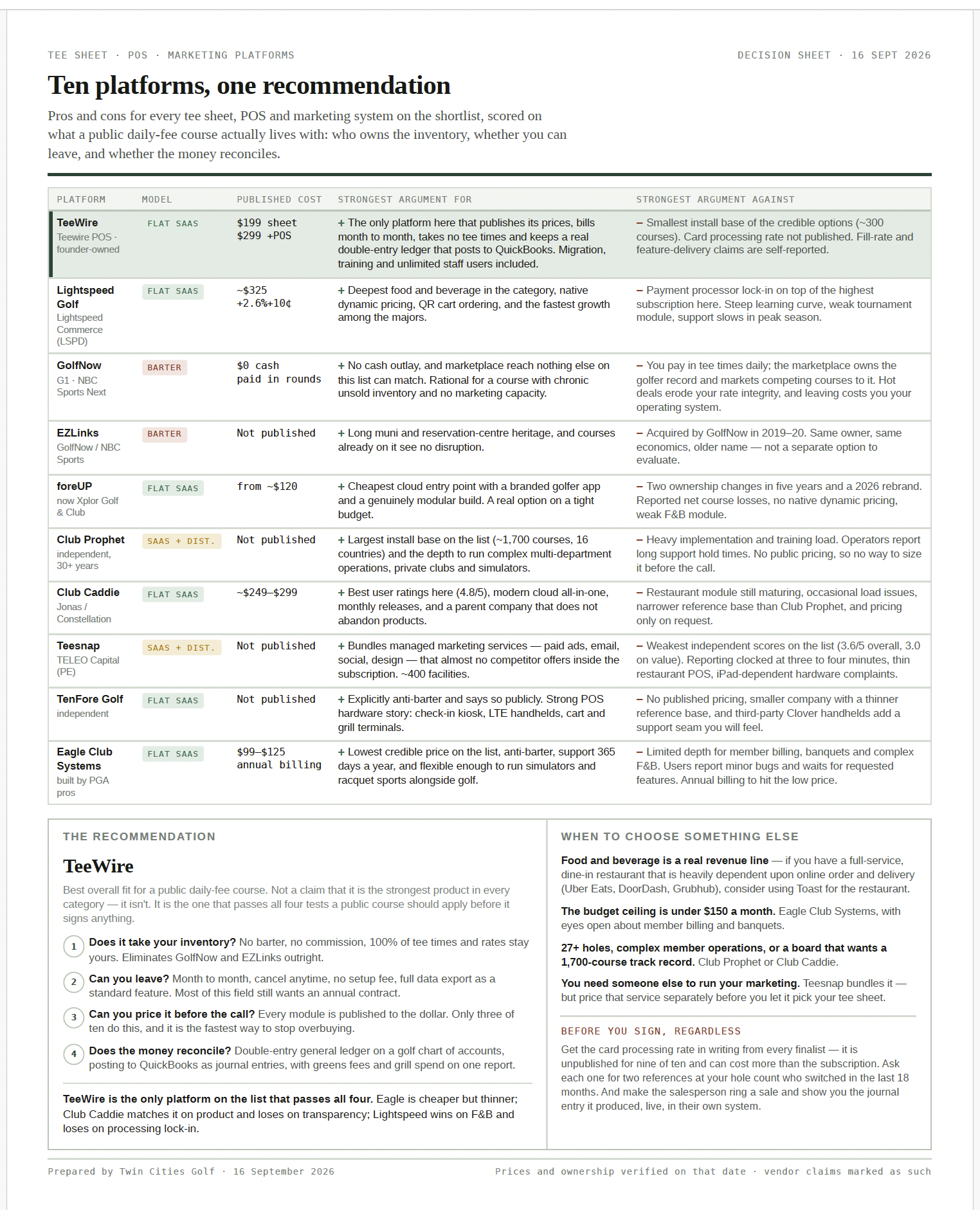
CLAUDE
Read complete Claude.ai analysis at https://claude.ai/artifact/LERDCK61j1UQmpjbjDG8TB
CHATGTP
Source: https://chatgpt.com/s/t_6aaa9e37139881919dd3a264e9176450
I reviewed the current TeeWire website, the TwinCitiesGolf TeeWire overview, and current information from the competing platforms you listed.
For a golf course owner, I would evaluate these systems less as “tee-sheet software” and more as revenue/operating platforms. The biggest questions are: Who owns the golfer? Who owns the tee-time inventory? What is the true annual cost? How good is the POS/F&B operation? How effectively can you remarket to your golfers? How much staff time does the system save? And how difficult is it to leave?
TeeWire POS: what it actually is
TeeWire has evolved well beyond a basic tee sheet. It currently positions itself as a single-database golf management platform encompassing tee sheet, online booking, POS, F&B, beverage cart, member billing, accounting/general ledger, inventory, dynamic pricing, waitlist, event registration, marketing/messaging, rewards, staff time clock and course websites. (Twin Cities Golf)
The basic economic proposition is particularly interesting for public golf:
Course → Website/Marketing → Golfer → TeeWire booking → Tee sheet → POS → Customer database → Marketing → Golfer returns
Rather than:
Course → third-party marketplace → Golfer → marketplace booking → course
That distinction can become financially significant over several years.
1. No barter and no tee-time commission
This is probably the first thing I would examine as an owner.
TeeWire says it does not trade tee times, take commissions on rounds, or place its own marketplace between the course and golfer. The course controls rates, inventory and the booking page and retains the golfer relationship. (Teewire)
That makes its cost comparatively easy to model.
For example, TeeWire currently publishes an 18-hole price of approximately:
Tee sheet + online booking: $199/month
Golf POS: +$100/month
So the core combination is about:
$299/month / $3,588 annually
Additional modules include marketing, membership/billing, websites, event registration, e-commerce, banquets, kitchen display and others. (Teewire)
For an owner, however, I wouldn't compare $3,588 against another vendor's software invoice. I'd calculate:
True technology cost = subscription + payment costs + hardware + add-ons + commissions + barter inventory value + marketing services + website + staff administration
That number can produce a very different comparison.
Where TeeWire gets particularly interesting
Tee sheet + POS + customer data
The tee sheet and POS operate against the same records. TeeWire says a golfer's golf purchase and subsequent F&B spending can therefore appear together rather than living in disconnected systems. It also maintains a double-entry general ledger underneath the POS and can export journal entries to QuickBooks. (Twin Cities Golf)
For an owner, that potentially means better answers to questions such as:
Who are my 500 highest-value golfers?
Who plays 10+ rounds but never buys F&B?
What is revenue per golfer rather than simply green-fee revenue?
Which customer segments respond to promotions?
That's where an integrated system can start generating revenue instead of merely processing transactions.
Waitlist / unused inventory
TeeWire has a waitlist that lets golfers specify the days/times they want. When appropriate inventory opens, the system can send the golfer a booking link.
That's important because an unsold 9:10 Saturday tee time disappears forever once 9:10 passes.
TeeWire also promotes “smart matching” of smaller groups and says its system has increased average occupancy from 3.1 to 3.8 golfers per tee time. That's a vendor-published claim, so I would ask TeeWire to demonstrate the underlying data and show comparable-course results before building an ROI model around it. (Twin Cities Golf)
Marketing
The marketing opportunity is more important than many owners realize.
Because reservations, golfer profiles and POS activity are connected, TeeWire offers email/SMS messaging based on the underlying golfer data, including operational messages such as confirmations, reminders and weather/frost-delay communications. (Twin Cities Golf)
That potentially allows much more targeted campaigns than simply emailing 20,000 people:
Played 3+ rounds this year
Hasn't played in 30 days
Lives within 25 miles
Normally plays weekday afternoons
Send Wednesday afternoon offer
That's the direction I would push TeeWire during a demo.
TeeWire vs. the competitors
Here's how I would position the field based on the platforms' current published capabilities.
PlatformPrimary strengthPOSMarketingDirect bookingMarketplace reachBarter concernOwner considerationTeeWireUnified course-controlled platformStrongStrongYesLimited vs GolfNowNo barterOwnership/control + transparent pricingLightspeed GolfMature technology ecosystemExcellentExcellentYesChronogolf marketplaceGenerally subscription modelSophisticated platform/analyticsGolfNowGolfer distribution/reachStrongVery strongYesExceptionalPotentially significant depending on contractDistribution vs inventory economicsEZLinksGolfNow ecosystem/legacy technologyStrongStrongYesGolfNow ecosystemContract dependentEvaluate within current GolfNow offeringforeUPEstablished all-in-one golf platformStrongStrongYesIntegrationsContract dependentMature golf-specific ecosystemClub ProphetDeep operational functionalityExcellentStrongYesIntegrationsNo barter for its direct reservationsParticularly strong complex/private/resort operationsClub CaddieModern all-in-one platformStrongStrongYesMultiple integrationsDepends on distribution partnersBroad functionality/mobileTenForeModern enterprise/all-in-one architectureExcellentIntegrationsYesIntegrationsContract dependentVery interesting multi-course/complex facilitiesEagle Club SystemsSimplicity/value/supportStrongStrongYesMore limitedDirect modelAttractive smaller/midsize operator option
There are nuances behind this table that matter.
TeeWire vs. Lightspeed Golf
Lightspeed is one of the strongest comparisons.
Lightspeed says it serves more than 2,000 golf courses and combines tee sheet, retail POS, F&B, payments, reporting, booking, websites/apps and marketing. (Lightspeed)
Its marketing ecosystem is particularly sophisticated: targeted email, behavioral automation, dynamic pricing, website/digital marketing services, Reserve with Google and access to the Chronogolf marketplace, which Lightspeed says reaches more than six million golfers. (Lightspeed)
TeeWire advantage: simplicity, transparent published pricing, no barter, direct founder/developer access, course ownership of the booking relationship.
Lightspeed advantage: scale, mature POS ecosystem, analytics, marketing infrastructure, integrations and marketplace reach.
For a larger resort/multi-course operation, Lightspeed deserves serious consideration.
TeeWire vs. GolfNow for Business
This is the most strategically different comparison.
GolfNow's enormous advantage is distribution. GolfNow says its technology provides access to approximately 3.9 million active bookers and GolfPass members. Its platform includes tee sheet, POS, payments, dynamic pricing, analytics, mobile functionality and marketing. (GolfNow for Business)
GolfNow therefore potentially solves a problem TeeWire does not solve to the same degree:
“I need golfers I don't already have.”
But the owner needs to examine the economics of the specific GolfNow agreement carefully, especially any inventory/barter component.
Suppose two prime foursomes per day were effectively worth:
8 golfers × $55 × 200 days = $88,000 retail inventory annually.
Even after applying realistic utilization and discount assumptions, the economic cost could dwarf a few thousand dollars of software expense.
That doesn't automatically make marketplace distribution unattractive. It means barter inventory needs to be treated as a marketing/customer-acquisition expense, not as “free software.”
GolfNow's reach is genuinely differentiated; TeeWire's ownership/control model is genuinely differentiated.
TeeWire vs. foreUP
foreUP is probably one of TeeWire's most direct competitors.
foreUP says it serves more than 2,300 courses and clubs and offers tee sheet, POS, billing, F&B, email/text marketing, tournament management, websites, managed marketing, payments and branded mobile apps. (foreUP)
foreUP has some compelling revenue tools, including back-nine booking, automated reminders and online prepayment designed to combat no-shows. (foreUP)
foreUP advantage: scale, established customer base, mature feature set and integrations.
TeeWire advantage: published pricing, month-to-month positioning, single-database architecture and unusually direct access to the development/support organization.
I'd put both on the demo list for a typical public daily-fee course.
TeeWire vs. Club Prophet
Club Prophet is a heavyweight operational system.
It says more than 1,400 facilities use its software and offers POS, tee sheets, F&B, member management, marketing, payments and inventory. Its POS has particularly deep inventory, billing and customer-management functionality. (Club Prophet)
Club Prophet also integrates with Priswing for predictive dynamic pricing using factors including demand, historical performance, weather and golfer behavior. (Club Prophet)
And importantly, Club Prophet explicitly advertises its own online reservations as no barter/no third-party booking fee. (Club Prophet)
So I would not characterize this simply as TeeWire = no barter and everybody else = barter. That's inaccurate.
Club Prophet becomes particularly compelling for a sophisticated operation with memberships, significant F&B, resorts or complicated accounting requirements.
TeeWire vs. Club Caddie
Club Caddie has built a broad modern golf-management platform with tee sheet, POS and mobile capabilities.
An interesting differentiator is distribution flexibility: Club Caddie says courses can optionally distribute inventory through providers including GolfNow, PGA Tee Times, Supreme Golf and others. (Club Caddie)
That creates an interesting middle-ground strategy:
Own the primary golfer relationship but selectively distribute distressed inventory.
That's something I would explore carefully.
TeeWire vs. TenFore Golf
TenFore deserves more attention than it sometimes gets.
Its platform is proprietary and connects tee sheet, POS, payments and booking. It offers sophisticated F&B, dynamic pricing, SMS/email communication, multi-course management, mobile POS, branded apps, kiosks and open-API integrations. (TenFore Golf)
Its multi-course architecture looks particularly compelling. TenFore also includes data migration as part of implementation.
An indication of its enterprise capability: in 2026, the City of San Diego authorized a contract with TenFore for POS and reservation services covering its three city-operated golf complexes. (San Diego Document Center)
I'd absolutely include TenFore if you're operating several courses, municipal facilities or a high-volume operation.
TeeWire vs. Eagle Club Systems
Eagle is another interesting value competitor.
It offers tee sheet, POS, F&B, billing, inventory, customer/member management, payments, marketing and reporting. It also advertises Google Appointment Redirect integration and QuickBooks Online integration. (Eagle Club Systems)
Third-party pricing information currently shows approximately $1,500/year for tee sheet/online booking and $3,900/year for its intermediate package including POS, F&B, inventory, billing, email and text messaging. Verify those numbers directly before relying on them contractually. (Capterra)
That's very competitive with TeeWire economically.
What I would ask EVERY company during the demo
Don't let them give you the standard PowerPoint demo. Give each vendor the same real-world tests.
Book a foursome online and show me every click the golfer makes.
Check those four golfers in and split payment four ways.
Cancel one golfer and show exactly how the inventory is remarketed.
Show me every customer who played 5+ rounds last year but hasn't played this year, then send that segment an email/text campaign.
Show me revenue per golfer including golf + merchandise + F&B.
Change Saturday's rate from $69 to $79 and show everywhere it changes.
Send a frost-delay text to tomorrow's 7:00–9:00 golfers.
Show me exactly what happens when the internet goes down.
Show me my P&L/GL entries from today's transactions and the QuickBooks workflow.
Export my entire golfer/customer database while I'm sitting here.
Show me your audit log: who changed a tee time, rate, transaction or refund?
Give me the TOTAL five-year cost—including software, hardware, processing, marketing, websites, texting, add-ons, implementation and tee-time inventory/barter.
That last question may be the most important.
The financial model I'd use
For a public 18-hole course doing 35,000 rounds at $55 average golf revenue, you're dealing with roughly:
$1.925 million annual golf revenue.
A system that increases realized revenue per round by only:
$2 = $70,000/year
Or increases utilization by:
1 additional golfer × 25 tee times/day × 150 days × $55 = $206,250
Obviously that simplified calculation assumes the incremental player would otherwise have gone unsold, but it illustrates the point.
Saving $2,000 on software isn't particularly important if another system produces $50,000 more revenue.
Conversely, paying for “free” software with $40,000–$80,000 of valuable tee-time inventory isn't inexpensive simply because there isn't a software invoice.
The shortlist I would investigate first
For a public daily-fee golf course focused primarily on revenue growth, marketing, golfer-data ownership and operational efficiency, I would put these five through the same demo:
TeeWire — Lightspeed — foreUP — TenFore — Club Prophet
Then I would separately evaluate GolfNow as a distribution/customer-acquisition strategy, rather than treating it strictly as a software comparison.
Club Caddie and Eagle Club Systems would remain credible alternatives, especially if their pricing or particular workflows fit the operation better.
The biggest potential attraction of TeeWire isn't simply the $299-ish core monthly price. It's the combination of direct booking + no barter + customer-data ownership + tee sheet/POS integration + marketing + accounting + website + month-to-month terms. (Teewire)
The main thing I'd pressure-test is whether its relatively smaller scale versus Lightspeed, foreUP and GolfNow translates into any gaps in integrations, enterprise reporting, payment options, mobile functionality or distribution that matter to your operation.
If you want, I can next build a much deeper Golf Course Owner's Teesheet/POS Comparison Scorecard for all 9 systems—about 30 criteria covering pricing, barter, credit-card processing, POS, F&B, tee sheet, dynamic pricing, marketing, websites, Google integration, accounting, QuickBooks, memberships, reporting, data ownership, API/integrations, support and contract terms—so you can use it during vendor demos.
PERPLEXITY
Source: https://www.perplexity.ai/search/41a53405-4150-40d7-b1e9-209e7e420bd3
Teewire is a cloud-based golf-management platform positioned as a relatively simple, owner-controlled alternative to marketplace-heavy tee-time systems. Its main proposition is one connected record for tee times, golfer/customer data, POS, payments, and marketing—plus transparent month-to-month pricing and a stated no-commission/no-barter model.[teewire][teewire]
For an 18-hole course, TeeWire currently publishes a Core price of $299/month including its tee sheet, online booking, and built-in golf POS; setup, migration, support, and unlimited training are included. Optional modules such as email marketing, member billing, website, events, ecommerce, and kitchen display add cost. Verify the final scope and payment-processing terms in writing, because the site contains older and newer pricing references.[teewire][teewire]
Teewire at a glance
What is included
TeeWire says its core platform combines:
Cloud tee sheet and 24/7 online booking through your own website.
A native POS that handles green fees, pro-shop retail, food and beverage, beverage-cart transactions, member billing, gift cards, and a prepaid “Tee Wallet.”
A shared golfer record across reservation, check-in, and point of sale, which can reduce duplicate entry and improve customer-level reporting.
Built-in payment processing, customer database, waitlist, email and text communications, event registration, member billing, accounting, and website options.
Integrations that include QuickBooks Online/Desktop, Fiserv, Clover, Google Analytics, Google Business Profile, and Google Workspace.[teewire][teewire][teewire]
Commercial model
The commercial structure is a major differentiator:
TeeWire says it does not take a commission on tee times or require “barter” inventory—i.e., giving the vendor tee times to resell in exchange for software.
It publishes monthly pricing and advertises no setup fee, no long-term agreement, and cancellation at any time.
It says migration, U.S.-based support, and ongoing training are included.
For a 9-hole operation, TeeWire publishes $179/month for tee sheet plus online booking; adding POS is $100/month, or $279/month total. The newer pricing page lists $299/month for 18-hole Core with POS.[teewire][teewire][teewire]
That model can be especially attractive if your course already has sufficient local demand and you want to protect prime-time inventory, control your price architecture, and retain direct ownership of golfer relationships.
Revenue and efficiency
Revenue opportunities
TeeWire’s revenue levers center on optimizing direct bookings and repeat play rather than relying on a large third-party marketplace:
Direct website bookings: Golfers book through your branded site, so the course controls the transaction and customer relationship.
Dynamic pricing: TeeWire states its pricing tools can vary rates by time of day, day of week, season, weather, and booking behavior. It also describes a “Player Score” intended to identify patterns such as no-shows, short-shows, and late cancellations.[teewire]
Waitlist: The platform can notify golfers when matching inventory opens, which can help turn cancellations into recovered rounds.[teewire]
CRM marketing: Because sales and booking behavior sit in one system, you can segment golfers for messages such as “weekday afternoon regulars,” lapsed players, outing prospects, or high-spending pro-shop customers.
Cross-sell: A shared POS/tee-sheet record should make it easier to link a tee-time guest to retail, F&B, lessons, events, gift cards, or membership offers.
Efficiency opportunities
For the pro shop and clubhouse, the potential operational value is reducing handoffs:
Check in or ring up golfers from the tee sheet rather than re-entering information in a separate POS.
Use one customer record across bookings and purchases.
Reconcile tee-time payments, shop transactions, and F&B activity from a common platform.
Manage walk-ups, phone bookings, online reservations, and cancellations in one place.
Access cloud-based operations remotely rather than relying only on a clubhouse workstation.[teewire][teewire]
The practical test is not whether a vendor has all these features; most major alternatives do. It is whether its workflow lets a seasonal pro-shop employee complete a booking, check-in, payment, rain check, merchandise sale, and cancellation quickly and correctly during a Saturday-morning rush.
Competitor comparison
The table below compares the vendors at a strategic level. Features and commercial terms can vary by package, course type, number of holes, payment processor, hardware, and distribution agreement, so use this as a shortlisting guide—not a substitute for a written proposal.
PlatformTee sheet / POS approachMarketing and demand generationBest fitMain consideration versus TeeWireTeeWireNative cloud tee sheet, booking, POS, payment processing, customer records, member billing, accounting, and website options built around one database. [teewire][teewire]Direct-booking model, email/text, waitlist, dynamic pricing, and website-led customer ownership. [teewire][teewire]Independent public, daily-fee, smaller private, and value-conscious courses seeking a straightforward all-in-one system without inventory barter.Strong value/control proposition; confirm depth of enterprise reporting, F&B workflows, multi-course needs, APIs, hardware, and marketing automation against your exact operation.Lightspeed GolfBroad cloud commerce stack: golf tee sheet, online booking, payments, retail POS, restaurant POS, inventory, accounting integrations, reporting, and integrations such as Whoosh for certain private-club workflows. [lightspeedhq]Email/SMS, social-media and website tools, Google booking, dynamic pricing, and the Chronogolf marketplace, which Lightspeed says reaches more than 6 million golfers. [lightspeedhq]Courses with meaningful retail/F&B complexity, multi-channel sales, or a need for a larger commerce ecosystem.Likely a stronger fit if your restaurant, retail inventory, omnichannel commerce, or integrations are highly sophisticated; compare total subscription, payments, modules, and implementation costs rather than base price.GolfNowGolfNow Pro is positioned for daily-fee and semi-private operations with cloud tee sheet, POS, payments, mobile check-in, booking engine, reporting, and website capabilities. GolfNow Premier targets private/resort clubs. [business.golfnow][golfnow]Its key advantage is the GolfNow/TeeOff affiliate marketplace and large golfer audience; it also provides marketing tools and marketplace placement options such as Spotlight. [business.golfnow][business.golfnow]A course that needs demand generation fast, particularly for off-peak inventory or a destination/new-market audience.The principal trade-off is marketplace economics and inventory control. Ask exactly which times, discounts, commissions, barter arrangements, rankings, and customer-data rights apply. A reseller can consume a substantial share of tee-time revenue; Lightspeed cautions that some arrangements can reach 60% of a sale. [lightspeedhq]EZLinksEstablished tee-sheet ecosystem with reservation management, online booking capabilities, lottery workflows, and historically integrated POS functionality. [ezlinks][ezlinks]Historically emphasizes network distribution, round sharing, outbound email marketing, and identifying weak tee-sheet periods for targeted offers. [ezlinks]Facilities that value legacy golf-industry workflows, regional network access, or specific established integrations.Obtain a current demo and current contract schedule: readily available public product documentation is more fragmented/older than for some rivals. Clarify current POS architecture, marketing suite, marketplace obligations, integrations, and data ownership.foreUPCloud-based golf-management system with tee sheet, POS, retail/F&B monitoring, prepaid online tee times, gift cards, memberships, lessons, and inventory tools. [foreupgolf]Email and text marketing, automated reminders, revenue-focused tee-sheet features, and pricing/booking tools. [foreupgolf]Public and semi-private facilities seeking a mature, feature-rich golf-specific operating system.A close functional competitor if you want deeper operational breadth. Compare implementation support, usability, package/module pricing, F&B needs, reporting, and whether the revenue-optimization workflow fits your team better than TeeWire’s simpler model.Club ProphetMature golf-management platform connecting tee sheet, POS, F&B, retail, inventory, member/customer management, payments, reporting, and multi-course workflows. Its Starter Hut tee sheet integrates with POS and supports groups, events, utilization, forecasting, and no-show tracking. [clubprophet][onlinehelp.cps]Marketing Hub includes websites, social media, review management, email, and text campaigns; dynamic pricing integration is available through Priswing. [clubprophet][clubprophet]Public, daily-fee, municipal, private, or multi-course operators that need configurable and established golf workflows.Often worth a serious look if your needs are complex—multiple courses, events, detailed utilization, or comprehensive operations. Test implementation burden and staff training requirements against TeeWire’s streamlined positioning.Club CaddieComprehensive cloud suite for public, semi-private, and private clubs, including tee sheet, booking engine, pro-shop/F&B/mobile POS, member management, billing, inventory, leagues, events, banquets, websites, accounting reporting, and staff tools. [clubcaddie][clubcaddie]Email, text, websites, mobile apps, event registration, and optional third-party distribution including PGA Tee Times, GolfBack, TeeOff, Supreme Golf, GolfBook, and GolfNow. [clubcaddie][clubcaddie]Full-service clubs, resorts, facilities with F&B/events, or operators wanting a wide menu of modules and a branded member/golfer app.Likely broader and potentially more complex than TeeWire. Evaluate whether you will use its wider club, banquet, app, and multi-venue functionality enough to justify price, setup, training, and operational complexity.TenForeNative cloud platform with tee sheet, POS, payments, booking engine, kiosks, branded mobile app, single inventory across departments, F&B routing, customer portal, and multi-course views. [tenfore][golfbusinessconference]Direct tee-sheet email/SMS, branded app, customer portal, promo codes, packages, loyalty-style features, waitlist, confirmations, and reporting. [tenfore][golfbusinessconference]Operators wanting a modern, mobile-first all-in-one system, especially multi-course facilities or properties with significant F&B and self-service ambitions.Probably the closest “modern native platform” comparison. TenFore may offer more visible kiosk/mobile/multi-course and cross-department POS depth; request side-by-side demos focused on speed, reporting, conversion, support, and total cost.Eagle Club SystemsCloud system built by PGA professionals covering tee sheet, online booking, POS, memberships/billing, F&B, payment processing, reporting, tournaments, inventory, customer data, email/SMS, and loyalty. [eagleclubsystems][capterra]Distinctive managed-marketing angle: custom graphics, promotions, branded visuals, social-media management, email marketing, and a dedicated marketing representative in some offerings. [eagleclubsystems][golfcoursetechnologyreviews]Owners who want both operational software and more hands-on outsourced marketing assistance.Consider Eagle if your bottleneck is marketing execution rather than only software. Confirm what is included versus separately billed in managed marketing, who owns creative/data/accounts, response-time commitments, and the real annual package cost.
What to verify
Before you select any provider, request a written answer and a live workflow demo for the following. These questions will expose differences that feature lists conceal.
Economics and ownership
All-in first-year and three-year cost: Subscription, POS modules, per-location fees, implementation, conversion, training, hardware, peripherals, integrations, payment fees, texting/email overages, website hosting, and annual escalators.
Marketplace and barter terms: Are you required to give the vendor tee-time inventory? Which times, how many, who sets the rate, what happens to unused inventory, and what revenue/commission is retained by the vendor? This is particularly important with marketplace-led options such as GolfNow.
Customer data rights: Who owns golfer names, emails, mobile numbers, purchase history, booking history, marketing consent, and the ability to export all of it if you leave?
Exit plan: What format is your full data export? Is it included? How long does it take? Can you keep your website booking links and payment-history records?
Operations and payments
Your actual busiest-hour workflow: Ask each vendor to demonstrate, live:
Four-player online prepay reservation.
Walk-up single joining an existing group.
Rain check and partial refund.
No-show and cancellation policy enforcement.
Golf fee plus retail plus F&B on one ticket.
Member charge account and guest pricing.
Beverage-cart order and kitchen/bar routing.
Event, league, shotgun, and multi-tee start workflows if relevant.
Payments: Get effective card-processing rates and every fee in writing, including gateway, PCI, batch, chargeback, terminal, early termination, and whether you can use another processor.
Hardware and continuity: Verify tablets/registers, receipt and kitchen printers, cash drawers, barcode scanners, mobile devices, offline capability, Wi-Fi dependence, and support coverage during a weekend outage.
Revenue and marketing
Demand strategy: Ask each vendor to show how it:
Fills Monday–Thursday and afternoon inventory.
Protects Saturday prime-time rate integrity.
Handles dynamic pricing rules and overrides.
Recovers cancellations through a waitlist.
Targets lapsed golfers without discounting everyone.
Measures campaign-to-booking and campaign-to-revenue conversion.
Reporting: Require a sample of daily close, tee-time utilization, pace/no-show report, booking-channel mix, source of customer acquisition, golfer lifetime value, average revenue per round, retail/F&B capture per golfer, and prebook rate.
Implementation: Confirm timeline, assigned migration owner, data cleanup responsibility, staff training, go-live staffing, support hours, escalation process, and a reference call with a comparable facility.
Practical recommendation
If your priority is direct booking ownership, transparent published pricing, no tee-time inventory barter, and a simple unified tee sheet/POS, TeeWire deserves a strong place on the shortlist. Its stated $299/month 18-hole core-with-POS price is unusually easy to evaluate, while the month-to-month model lowers switching risk.[teewire]
I would evaluate it head-to-head with:
foreUP if you are a public or semi-private course wanting a mature golf-specific suite and stronger operational/revenue-management breadth.[foreupgolf]
TenFore if mobile POS, kiosks, a branded app, F&B routing, and multi-course capability are major parts of your strategy.[tenfore]
Lightspeed Golf if retail, restaurant operations, ecommerce, advanced inventory, or a larger commerce/integration ecosystem matter as much as tee-time management.[lightspeedhq]
Club Caddie or Club Prophet if you operate a more complex club, event/banquet business, extensive member program, or multiple facilities.[clubprophet][clubcaddie]
GolfNow as a selective demand-generation channel if you have chronic off-peak vacancy—but negotiate carefully to avoid sacrificing high-value inventory or long-term pricing control.[business.golfnow][business.golfnow]
A sound procurement process is to run the same 90-minute scenario-based demo and the same three-year cost worksheet with TeeWire, foreUP, TenFore, and one of Lightspeed/Club Caddie/Club Prophet based on your F&B and club complexity. Choose the vendor that best improves net revenue per available tee time, not merely the one with the lowest monthly software price or the largest marketplace.
GEMINI
As a golf course owner, evaluating your Tee Sheet, Point of Sale (POS), and marketing software is one of the most consequential decisions you can make for operational efficiency and bottom-line revenue.
What You Need to Know About Teewire POS
Teewire (which merged with CourseLogix under the Teewire name) is an all-in-one Golf Course Management System (GMS) founded in 2016 by Bay Paul, a former Director of Golf and multi-course manager.
Key Highlights & Strengths for Golf Course Owners:
Truly Unified Database (Not Integrated Apps):
Many legacy vendors patch together separate apps for POS, tee sheets, websites, and F&B. Teewire runs 19 native modules—tee sheet, POS, member dues, F&B, beverage cart, accounting/GL, event registration, and your course website—on one single underlying database.
What this means for you: A golfer's tee time, pro shop purchase, and bar tab land on a single customer ledger, keeping accounting clean without clunky nightly syncs.
100% Barter-Free & Direct Booking:
Teewire operates strictly on a predictable software subscription model. They do not take tee time inventory (trade rounds) or charge booking commissions to your golfers. You keep 100% of your green fees and player data.
In-House Website & SEO Integration:
Born alongside CourseLogix (a golf website design firm since 2005), Teewire handles your public-facing website, SEO, and direct online booking engine out of the box, maximizing direct web conversions.
Operator-Driven Support & "Course Partner Council":
Support is 100% U.S.-based and led directly by the founder/engineering team.
Teewire utilizes a Course Partner Council feature request system where operators log, vote on, and track feature requests transparently (boasting over 340+ operator requests engineered live into the product in recent updates).
Operational Features:
Smart Tee Sheet Matching: Automatically pairs online 2-somes and 9/18-hole splits to optimize utilization (improving average slot density from 3.1 to 3.8 golfers per tee time).
Player Score & Smart Waitlist: Tracks no-show/short-show histories to automatically adjust player rules or auto-text waiting list golfers when cancellations occur.
No Setup Fees & Full Ownership: Free white-glove data migration (historical bookings, customer lists, gift cards) with standard, unrestricted data exports.
Competitor Comparison Matrix
VendorPrimary StrengthsBarter / Trade ModelBest Suited ForKey Owner ConsiderationsTeewire POS
• 100% unified single database
• Website + SEO native integration
• Direct line to software devs/founder
Barter-Free
(SaaS fee only)
Public, Semi-Private, & Municipal courses seeking simplicity, clean data, and fast U.S. supportDesigned by former course operators. Highly responsive dev cycle, but smaller market footprint than corporate giant aggregators.Lightspeed Golf
• Highly polished, modern UI
• Retail-grade inventory management
• Strong cloud architecture
Barter-Free
(SaaS fee only)
Courses with large retail pro shops, multi-location apparel, or complex inventory needsOriginally a general retail POS adapted for golf (acquired Chronogolf). Excellent inventory, but can require multi-module add-ons.GolfNow
• Massive consumer reach (GolfNow app/marketplace)
• Yield management algorithms
Heavy Barter Focus
(Takes trade tee times / booking fees)
Courses desperate for fill-in volume on off-peak tee timesTrade times undercut your direct rates and capture player email data. High revenue leakage if not strictly managed.EZ Links
• Deep enterprise distribution
• Corporate golf networks
Hybrid / Barter
(Owned by NBC / GolfNow)
Large public management companies requiring GolfNow network hooksOwned by GolfNow/NBC Sports. Shares the same trade-time ecosystem and legacy architecture challenges.foreUP
• Pure cloud-based pioneer
• Easy drag-and-drop tee sheet
• Broad marketing tools
Barter-Free or Hybrid
(SaaS fee option)
Mid-size public/private courses wanting an intuitive web interfaceAcquired by ClubEssentials Holdings. Powerful features, though some users report slower support cycles post-acquisition.Clubprophet
• Decades of reliability
• Deep enterprise billing & multi-course controls
Barter-Free
(SaaS fee option)
High-volume daily fee, municipal complexes, and multi-course ownersRobust, time-tested software, but traditional user interfaces can feel less modern than newer cloud platforms.Club Caddie
• Modern cloud stack
• Great all-in-one suite (F&B, Driving Range, POS)
Barter-Free
(Owned by Jonas Club Software)
Public daily fee & semi-private courses wanting all-in-one cloud F&B + GolfBacked by Jonas; strong growth in all-in-one cloud tech, but rapid feature expansion can occasionally mean frequent UI updates.Tenfore (GolfManager / Tenfore Systems)
• Flexible golf management platform
• Solid custom reporting
Barter-FreeRegional daily-fee and public courses looking for tailored setupsSmaller market presence; requires confirming local hardware/payment gateway compatibility.Eagle Club Systems
• Simple, low-cost daily fee tee sheet & POS
• Lightweight footprint
Barter-FreeBudget-conscious or smaller 9-hole/18-hole public coursesEasy to learn, but lacks deep marketing automation, advanced dynamic pricing, or native website/SEO engines.
Core Questions to Ask When Choosing Your Platform
To help narrow down the right platform for your course's specific operational needs:
Trade Times vs. Subscription: Does your course rely on GolfNow’s marketplace to fill empty slots, or are you looking to eliminate trade times, build a direct customer database, and keep 100% of green fee revenues?
Food & Beverage (F&B) Needs: Do you run a simple snack bar, or a full-service restaurant/banquet hall that requires split checks, kitchen display systems (KDS), and complex table management?
Data Ownership & Marketing: Do you want an all-in-one solution that automatically manages your website SEO, player text messaging, and automated email marketing under one roof?
COPILOT
As a golf course owner, the key question is not just "Which tee sheet is best?" but rather which platform will help me maximize rounds, capture more revenue per golfer, reduce staff workload, and strengthen customer relationships without giving away control of my business.
After reviewing https://www.teewire.com and the TeeWire information provided online, here is my assessment.
Executive Summary
positions itself differently than most golf technology vendors. Rather than focusing solely on tee time distribution or POS software, it offers a fully integrated golf course management platform with:
Tee sheet
Online tee time booking
POS
Marketing
Website
Payment processing
Membership billing
Reporting
Customer database
All running from a single database and a single vendor relationship. The company emphasizes that courses keep ownership of their golfers and tee times, publishes pricing openly, offers free migration, and provides U.S.-based support. [teewire.com], [teewire.com]
For many public, municipal, daily-fee, and multi-course operators, that philosophy is very different from marketplace-driven providers that monetize tee time inventory. [teewire.com], [golfnow.com]
What Makes TeeWire Different?
According to TeeWire:
1. One Database
Most golf operations end up with:
Tee sheet from one company
POS from another
Website from another
Marketing from another
TeeWire combines all functions into one platform, eliminating synchronization issues between systems. [teewire.com], [teewire.com]
Owner Benefit:
Less duplicate data entry
More accurate customer reporting
Better staff efficiency
2. Your Customers Stay Yours
TeeWire repeatedly emphasizes:
"Every tee time stays yours, and so does every golfer." [teewire.com]
This is important because many golf operators feel large tee-time marketplaces train golfers to book through third parties rather than directly with the golf course.
Owner Benefit:
More direct customer relationships
Better email marketing opportunities
Lower dependence on outsiders
3. Marketing Included
Unlike many POS-centric systems, TeeWire includes:
Course websites
SEO
Email marketing tools
Customer database access
Booking integration
One TeeWire customer reported a significant increase in rounds due to improved search visibility and integrated booking. [teewire.com]
Owner Benefit:
Increased direct bookings
Reduced need for external marketing vendors
4. Built-In POS
The POS and tee sheet use the same database. When a golfer books, checks in, buys merchandise, purchases food, or redeems a gift card, the information remains connected. [teewire.com]
Owner Benefit:
Faster check-in
Better customer tracking
Integrated reporting
5. Strong Operator Involvement
TeeWire's "Council" allows client courses to submit and vote on product enhancements. The company claims a very high percentage of requested features are delivered. [teewire.com]
Owner Benefit:
Product roadmap shaped by operators rather than investors.
How TeeWire Compares to Competitors
TeeWire vs Lightspeed Golf
Lightspeed Strengths
Large established company
Sophisticated inventory tools
Strong retail POS
Mature tee sheet platform (Chronogolf) [academy.li...peedhq.com], [lightspeedhq.com]
TeeWire Strengths
Golf-only focus
More personal support
Published pricing
Website + marketing emphasis
Direct developer access [teewire.com]
Best Fit
Lightspeed
Larger clubs
Retail-heavy golf facilities
TeeWire
Daily fee and municipal courses wanting personal support and marketing help
TeeWire vs GolfNow
GolfNow Strengths
Massive golfer marketplace
Dynamic pricing tools
National marketing reach
Large customer base [golfnow.com], [golfnowbusiness.com]
TeeWire Strengths
No dependence on marketplace bookings
Greater ownership of customer data
Focus on direct bookings
Integrated website strategy [teewire.com], [teewire.com]
Best Fit
GolfNow
Course needs outside demand immediately
TeeWire
Course wants to build long-term direct customer relationships
TeeWire vs EZLinks
EZLinks Strengths
Long industry history
Strong resort and management company presence
Marketplace integrations
Dynamic pricing options [Tee Times - EZLInks], [ezlinks.com]
TeeWire Strengths
More modern cloud-first positioning
Simpler vendor relationship
Marketing and web included
More transparent messaging around customer ownership [teewire.com]
Best Fit
EZLinks
Established resorts and enterprise operations
TeeWire
Public, municipal and independent operators
TeeWire vs foreUP
foreUP Strengths
Very large user base
Comprehensive feature set
AI dashboards
Advanced tee sheet optimization [foreupgolf.com], [foreupgolf.com]
TeeWire Strengths
Smaller company support model
Direct product influence
Website and marketing emphasis
Simplicity [teewire.com]
Best Fit
foreUP
Data-driven operators seeking extensive functionality
TeeWire
Operators seeking ease-of-use and direct support
TeeWire vs Club Prophet
Club Prophet Strengths
Deep functionality
Strong private club support
Robust POS and F&B
Long industry history [clubprophet.com], [clubprophet.com], [onlinehelp.cps.golf]
TeeWire Strengths
Simpler ecosystem
Website and marketing focus
More modern cloud-centric messaging
Easier for public courses [teewire.com]
Best Fit
Club Prophet
Private clubs and complex operations
TeeWire
Daily fee and municipal facilities
TeeWire vs Club Caddie
Club Caddie Strengths
Deep functionality
Mobile apps
Event management
Simulator support
Strong all-in-one platform [clubcaddie.com], [golfcourse...eviews.org]
TeeWire Strengths
Simpler experience
Marketing and SEO focus
Direct support model
Published pricing approach [teewire.com]
Best Fit
Club Caddie
Clubs wanting lots of operational tools
TeeWire
Operators wanting an easier-to-manage platform
TeeWire vs TenFore
TenFore Strengths
Modern cloud-based architecture
Strong resort integrations
Comprehensive platform [thegolfwire.com], [tenfore.golf]
TeeWire Strengths
Longer operating history (since 2005)
Marketing expertise
Strong Midwest golf course presence
Direct development interaction [teewire.com]
Best Fit
This is one of the closer comparisons.
TeeWire vs Eagle Club Systems
Eagle Strengths
Affordable positioning
Growing user base
Strong all-in-one platform
Extensive operational modules [eagleclubsystems.com], [eagleclubsystems.com]
TeeWire Strengths
Stronger marketing orientation
Website development expertise
Long-standing golf website background
More emphasis on golfer acquisition and SEO [teewire.com]
Best Fit
Eagle
Cost-conscious operators
TeeWire
Revenue-growth-focused operators
My Recommendation as an Owner
If your top priorities are:
✅ Increasing direct bookings
✅ Improving search engine visibility
✅ Building your own customer database
✅ Eliminating multiple vendors
✅ Having one support contact
✅ Avoiding tee-time inventory barter models
then TeeWire deserves serious consideration and should be on your final shortlist alongside foreUP, Club Caddie, and Lightspeed. [teewire.com], [foreupgolf.com], [clubcaddie.com]
My 2026 Ranking by Course Type
Course TypeTop ChoicesPublic Daily FeeTeeWire, foreUP, Club CaddieMunicipalTeeWire, Eagle, foreUPResortLightspeed, EZLinks, TenForePrivate ClubClub Prophet, Club Caddie, LightspeedMulti-Course OperatorforeUP, Club Prophet, TeeWire
For most independently owned public golf courses focused on growing rounds and keeping customer relationships under their own control, TeeWire's combination of tee sheet + POS + website + marketing may provide one of the strongest revenue-growth value propositions in the market today. [teewire.com], [teewire.com]
GROK
Source: https://grok.com/share/bGVnYWN5LWNvcHk_611351e2-8e03-4f3b-b3d8-8e1afd5d54b5
**TeeWire (often styled Teewire) is a U.S.-based all-in-one golf course management platform** focused on tee sheet, online booking, POS, marketing, member billing, accounting, and course websites, all running on a single database.
### Key points for a golf course owner
- **What it includes**: Native tee sheet (browser-based, works on computer/tablet/phone; designed so seasonal staff can learn it in one shift), online booking engine (white-label on your site, no third-party marketplace), built-in POS (pro shop, F&B, beverage cart—all on the same records as the tee sheet so a round + grill spend appears as one customer line), waitlist with notifications, dynamic/behavioral pricing (including a “Player Score” based on no-show/short-show history, pace, weather, location), text/email marketing and messaging (e.g., frost delay alerts tied to existing bookings), member/dues billing, double-entry general ledger (pushes journal entries to QuickBooks), inventory, event/banquet registration, lesson booking, rewards, staff time clock, and course website tools. Multi-course reporting is available. Courses turn modules on as needed.
- **Business model**: Flat monthly SaaS subscription. **No commissions on rounds and no barter/trade of tee times**. You keep 100% of inventory, set your own rates, own the golfer relationship and data (full export anytime), and book via your own branded page. Payment processing is built-in (one merchant account; options include pay-in-full at booking, card-on-file to cut no-shows, or pay at the shop). Unlimited staff users at no extra cost.
- **Pricing (publicly posted, month-to-month, cancel anytime)**: Core (tee sheet + online times + POS) starts around $179–$299/month depending on holes (examples: ~$179 for 9-hole, ~$199–$299 for 18-hole with POS). Add-ons (waitlist/dynamic pricing, marketing, website, etc.) are incremental. Setup, migration, and training included at no charge. Processing fees are standard (e.g., ~2.9% + $0.30 cited in some materials). Cold-climate or annual billing discounts may apply.
- **Support & development**: 100% U.S.-based and in-house. Founder Bay Paul (ex-golf operations VP with multi-course experience) is involved in support and product; courses can reach developers. Same-day callbacks emphasized. Unlimited free training. Course Partner Council lets operators submit/vote on feature requests (high delivery rate claimed in 2026 data).
- **Migration**: Handled by TeeWire at no charge; historical bookings, customers, pricing, gift cards, etc., transferred. Parallel run possible; existing booking URL can continue. Typical staff time ~2 hours once data is provided.
- **Strengths for revenue/efficiency/marketing**: Direct booking keeps more revenue and data in-house (vs. marketplace barter). Smart pairing aims to raise golfers per tee time. Behavioral pricing + waitlist targets no-shows/short-shows. Unified POS/accounting reduces reconciliation. Integrated marketing/messaging and website tools support reach without extra vendors. Testimonials cite round increases, ease for staff/golfers, and responsive support.
- **Considerations**: Smaller installed base (~300+ courses) than some larger competitors. Confirm exact current pricing, hardware needs (cloud, Clover terminals mentioned), and fit for your specific F&B/membership complexity via a demo on your own rates/sheet. Merged with CourseLogix (websites/marketing heritage since 2005).
TeeWire positions itself as operator-centric (founder has course experience, public feedback loop, transparent pricing, no inventory giveaways) versus larger or barter-oriented systems.
### Comparison overview vs. the listed competitors
All are cloud-oriented golf-specific (or golf-adapted) platforms covering tee sheet + booking + POS to varying degrees. Differences center on **commercial model (flat fee vs. barter/commission)**, **integration depth (true single database vs. bolted modules)**, **pricing transparency**, **support model**, **marketplace distribution**, and **scale**. Pricing is often quote-based and varies by modules/course size; figures below are approximate from public/industry sources and can change—always get current quotes. Data ownership, contract terms, and processing rates matter for long-term cost.
| Vendor | Model & Pricing Notes | Core Strengths | Potential Drawbacks | Best Fit Notes |
|--------|-----------------------|----------------|---------------------|---------------|
| **TeeWire** | Flat SaaS (~$179–$299+/mo core + POS); public pricing; month-to-month; no barter/commission; unlimited users; free migration/setup/training | Unified single-database (tee sheet/POS/accounting/website/marketing); U.S. in-house support with founder access; Player Score behavioral pricing; high feature request delivery | Smaller base; confirm advanced multi-property/F&B depth | Operators wanting control, transparency, direct booking, and responsive U.S. support without giving inventory |
| **Lightspeed Golf** (ex-Chronogolf) | Quote-based (~$300–$700/mo typical; some reports lower); no barter; month-to-month options | Strong retail/F&B POS heritage + inventory; dynamic pricing; cloud tee sheet; reporting/BI; multi-location | Quote-only pricing; support can lag in peak season; more commerce-oriented than pure golf in some views | Pro-shop-heavy or multi-course ops wanting robust retail/restaurant tools integrated with tee sheet |
| **GolfNow / EZ Links** (NBC Sports Next; EZLinks is the tee sheet/POS side) | Often low/zero software fee via **barter** (typically 1–3 tee times/day that GolfNow sells/keeps revenue); alternative cash options exist; large marketplace distribution | Massive golfer reach via GolfNow.com marketplace; dynamic pricing; integrated POS; call center options; scale | Barter opportunity cost can be high ($30k–$100k+/yr equivalent value depending on volume/rack rates); data/relationship shared; less control over pricing/inventory on marketplace channels | Courses prioritizing volume/distribution over keeping 100% of inventory/revenue; less ideal if you want full ownership |
| **foreUP** | Modular quote (~$120–$800+/mo range; archived POS ~$130, tee sheet ~$120, etc.; total often $400–$800); no barter | Mature cloud pioneer; modular (pay for what you use); solid POS, tee sheet, F&B, marketing, tournaments, BI; large installed base | Pricing not fully public; some reports of higher total cost or module complexity | Daily-fee/public courses wanting flexible modules and established cloud features |
| **Club Prophet** | Quote-based (modules: POS, tee sheet, F&B, billing, marketing, mobile); dual Signature/Cloud platforms; established player | Strong POS + tee sheet integration; member billing; F&B/mobile (CPS Air); tournament tools; multi-course (MCO) options; long history | Less public pricing detail; can feel more traditional depending on platform choice | Courses needing solid POS/billing + add-on flexibility, including multi-course |
| **Club Caddie** | Quote (~$299/mo common reports; some lower entry); no barter; Jonas Software ownership | Built by operators; all-in-one cloud (tee sheet, POS, CRM, marketing, events, memberships); strong support reputation in some reviews; Azure-native | Pricing varies; interface can feel complex to some | Public/semi-private courses seeking mid-market all-in-one with good support responsiveness |
| **TenFore** | Quote/SaaS (flat fee model); proprietary all-in-one; hardware incentives sometimes offered | Unified POS + tee sheet on same screens; integrated Fiserv/CardConnect payments (uptime claims, surcharging option); multi-course apps/kiosks; hotel integrations (Oracle Opera); Google Reserve | Newer/growing base; confirm long-term support depth | Multi-course, resorts, or ops wanting modern mobile/kiosk + payment flexibility and partner network |
| **Eagle Systems (Eagle Club Systems)** | Lower entry (~$99–$125+/mo reported for basic packages); no barter; fast setup | All-in-one by PGA pros; simple/cloud; tee sheet + POS + billing + marketing; quick live (days); U.S. support emphasis; good for smaller/municipal | Smaller scale; fewer advanced enterprise features in public materials | Smaller public, municipal, or simpler ops wanting affordable, easy-to-train all-in-one with quick migration |
### Practical takeaways for increasing revenue, efficiency, and marketing reach
- **Revenue**: Prefer systems that keep inventory and data yours (TeeWire, Lightspeed, foreUP, Club Caddie, TenFore, Eagle, Club Prophet) over pure barter (GolfNow/EZLinks core model). Look for dynamic/behavioral pricing, waitlists, smart pairing, and easy rate control. Marketplace reach (GolfNow) can fill soft times but at a real cost—calculate your barter opportunity cost carefully.
- **Efficiency**: True single-database unification (TeeWire emphasizes this strongly; Lightspeed, Club Caddie, TenFore, Eagle also strong) reduces double-entry and end-of-day reconciliation. Mobile/POS-from-tee-sheet and unlimited users help staff. Free/included migration + training lowers switching friction.
- **Marketing reach**: Integrated email/SMS + website tools (most have these; TeeWire and others highlight direct golfer lists) beat relying solely on third-party marketplaces. Branded booking + own data enables loyalty and targeted campaigns.
- **Other decision factors**: Contract flexibility (month-to-month vs. longer), data export, U.S. support quality, payment rates/hardware, and multi-course needs. Demo on *your* sheet/rates and ask the same operational questions of each (e.g., mid-period member minimums, journal entries from a sale, frost-delay messaging tied to bookings).
**Recommendation**: Start with demos of TeeWire (transparent pricing + no-barter + founder access) alongside 2–3 others that match your priorities (e.g., Lightspeed for retail depth, Club Caddie for mid-market all-in-one, GolfNow only if distribution is critical and you model the barter cost). Ask specifically about current total cost of ownership (software + processing + any hidden fees), migration timeline, and support SLAs. Industry sources note ongoing shifts away from pure barter models as courses reclaim inventory. Verify all details directly—features and pricing evolve.